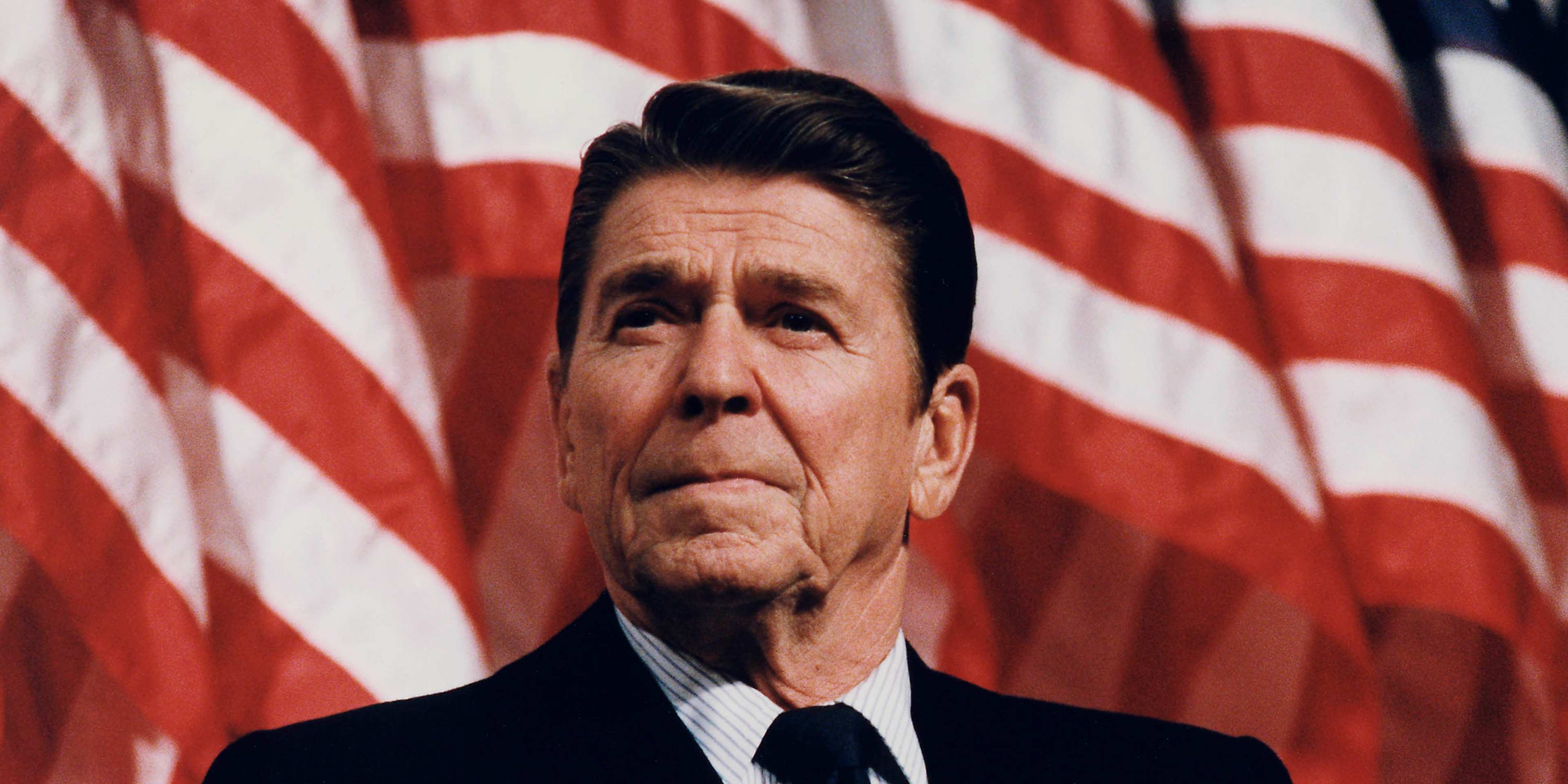
Heritage · United States · 1981 — 1989
The Gipper's legacy: from stagflation to the 1980s boom. How Reagan cut taxes, crushed inflation and created 16 million jobs — and why the deficit remains his original sin.
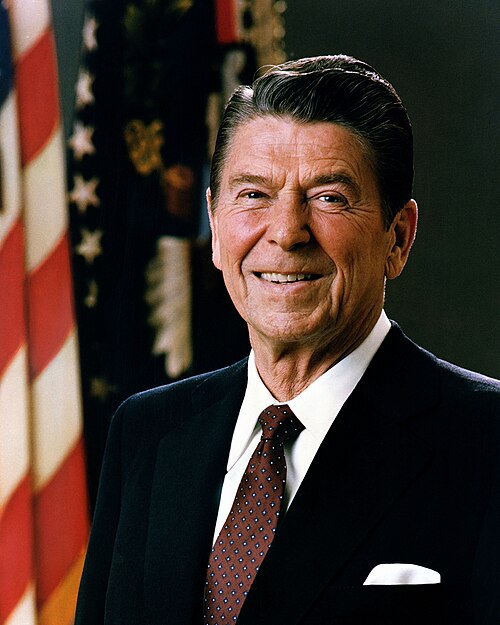
Want to understand Reagan? Start with Carter's "malaise" speech. July 1979: the President of the United States spends ten days at Camp David, then tells the nation that its problem is itself. Inflation exceeds 13%. Gas station queues look like Soviet breadlines. American hostages have been rotting in Tehran for nine months. The misery index — inflation plus unemployment — reaches 20.6 in 1980.
Reagan had a simple answer: this isn't a problem of American spirit. It's a problem of economic policy. Government has grown too large, taxes are too high, the currency is badly managed. "Government is not the solution to our problem; government is the problem." He won the election 489 electoral votes to 49.
Reagan's first budget, in February 1981, was the Economic Recovery Tax Act: the largest tax cut in American history at that point. The top marginal rate fell from 70% to 50% in one move. Then in 1986, the Kemp-Roth-Reagan Tax Reform Act went further still: just two rates, 15% and 28%. The American tax system had 16 tangled brackets. By 1988: two.
Reagan's argument was the same as Laffer's — his economic adviser who had sketched his curve on a restaurant napkin: if rates are too high, they discourage work and encourage tax avoidance. Cutting rates widens the tax base and can maintain revenues. And indeed, federal tax revenues rose from $517 billion in 1980 to $909 billion in 1988.
The 1982 recession was brutal. Unemployment climbed to 10.8% in December — the worst since the Great Depression. Reagan held course and backed Volcker at the Fed despite a 35% approval rating. The pain was concentrated and accepted. Then the V closed: 1983, +4.6% growth. 1984, +7.2% — the strongest since the 1950s.
Between 1983 and 1989, the American economy created 16 million net jobs. Unemployment fell from 10.8% to 5.3%. The phrase "Morning in America" — the 1984 campaign slogan — wasn't marketing: it was a reality Americans were living. Consumer confidence in 1984 was the highest in two decades.
This is the most honest objection one can make about Reagan. He cut taxes AND increased military spending. The federal deficit exploded: from $74 billion in 1980 to $221 billion in 1986. The national debt nearly tripled. How do you defend that?
The honest answer: Reagan made a choice. He wanted to win the Cold War — and he reckoned the United States could afford it if the economy restarted. Military spending rose from $134bn to $290bn. Tax revenues grew 76%. What didn't happen was the cut in civilian spending Reagan had promised and the Democratic Congress refused. The deficit is real. But its cause is spending — not the tax cuts.
Enriched the rich, trickle-down economics, exploded the deficit, it was Volcker not Reagan. These are the four strongest charges against him. Look closer.
Reagan didn't make Americans happy. He got them out of stagflation, out of the humiliation of hostages held in Tehran, and out of an economy that seemed out of control. American living standards saw their strongest post-war rise between 1983 and 1989. He paid a real cost — a structural deficit that weighed on his successors. But the alternative — the Keynesian inaction of the Carter years — led to hyperinflation and decline. He chose short pain over long agony. That's what governing means.