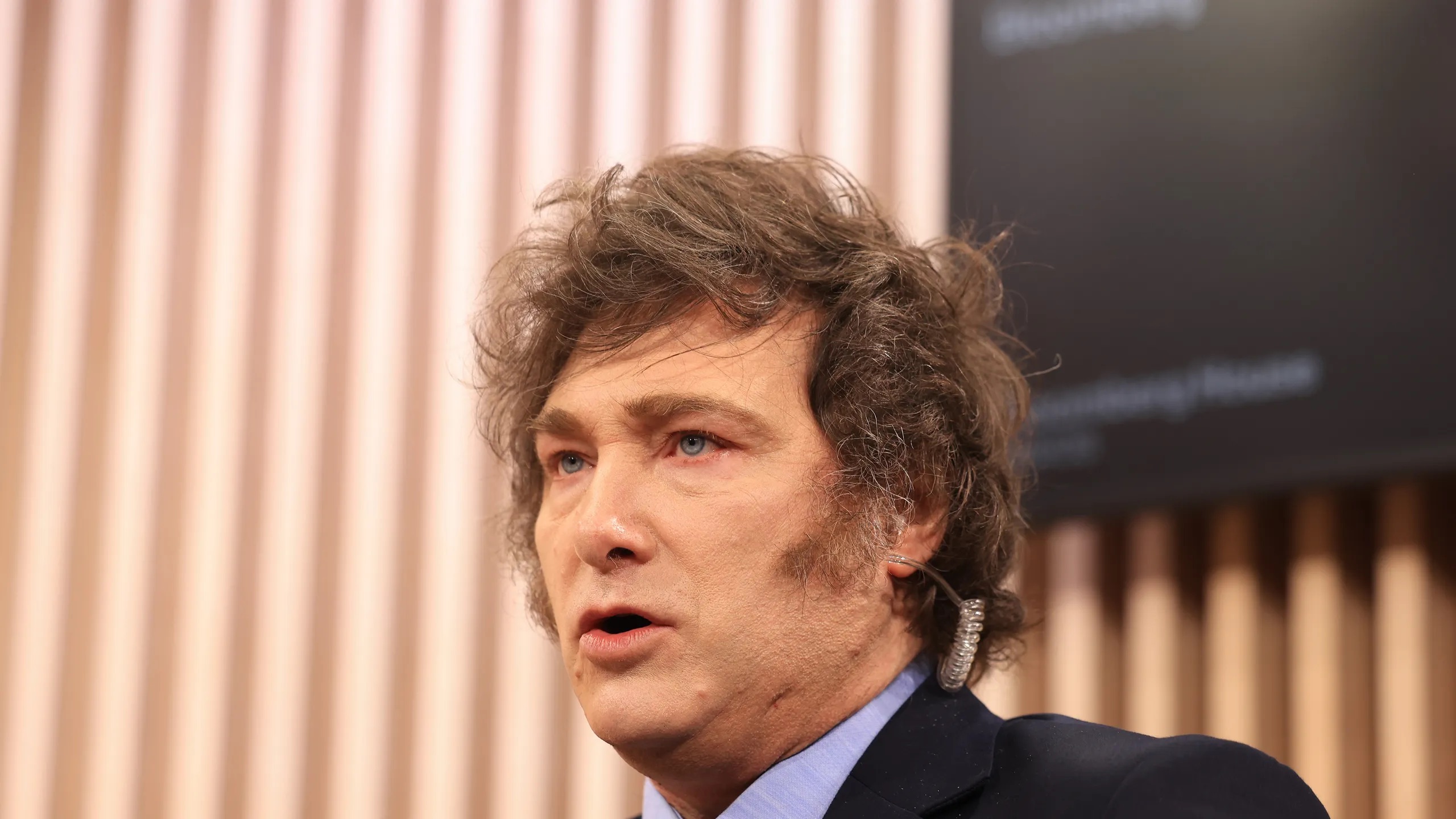
Javier Milei, President of Argentina
Javier Milei
Heritage 2023 — present
Heritage

Heritage · Argentina · since December 2023

Javier Milei

⚠️ Work in progress — mandate ongoing

The most radical liberal experiment underway: balanced budget in 6 months, inflation divided by 12, 1,246 deregulations in 18 months. The shock was real. The recovery is too. The final verdict is not yet in.

25% → 2% monthly inflation (Dec. 2023 → mid-2025, INDEC)
−5% → +1,8% inherited deficit → 2024 surplus (first in 14 years)
1 246 deregulations in 18 months (~2/day, Cato 2025)
Javier Milei, President of Argentina (since December 2023)
01

The Argentina inherited — a time bomb

When Milei is sworn in on 10 December 2023, he inherits a country on the brink. Annual inflation exceeds 211%. The fiscal deficit runs at 5% of GDP. Central bank net reserves are negative (−$11bn). The peso has lost 50% of its value in a year. Forty-five percent of the population lives below the poverty line.

This is no ordinary crisis. It is the product of four decades of fiscal populism: massive energy subsidies, pervasive price controls, deficit financed by the printing press. Every government that promised change made things worse. Milei is elected promising not incremental reforms, but the chainsaw.

"211% inflation. Net reserves: −$11bn. 45% poverty." Argentina on 10 December 2023 — inauguration day

Monthly inflation in Argentina since taking office (INDEC).

💡 The key takeaway In December 2023, monthly inflation hit 25.5% — annualised, nearly 1,000%. Eighteen months later, it sits around 2–3% per month. In Argentina, inflation is the main tax on the poor. Breaking it is the most powerful social reform possible.
02

The fiscal chainsaw — surplus in 6 months

In 2024, real public spending falls by 27%. Eleven ministries are merged or abolished. Fifty-two thousand civil service posts are eliminated. The national tax agency (AFIP) is dissolved. The result is stunning: primary surplus of 1.8% of GDP in 2024 — the first in 14 years. And for the first time since 2008, it is a financial surplus: debt is being serviced.

The comparison with previous attempts is striking. Argentina has passed through 22 IMF programmes since 1958 — all failed because no government held to its fiscal commitments. This time, Milei restored balance first, then the IMF delivered $20bn (April 2025). It is the first time the sequence has worked this way.

"−5% of GDP inherited → +1.8% surplus. In 6 months." Primary balance — Ministerio de Economía de Argentina

Primary fiscal balance (% of GDP) before and after the reforms.

💡 The key takeaway An Argentine surplus is anything but obvious. The country had not seen one in 14 years on the primary measure, nor since 2008 on the financial measure. This is not just an accounting figure — it is a break with half a century of addiction to public spending financed by the printing press.
03

1,246 deregulations — at a rate of two a day

The regulatory revolution is as dramatic as the fiscal one. In 18 months, 1,246 deregulations are implemented (Cato Institute, 2025). Capital controls — in place since 2019 — are lifted in April 2025. The dual exchange rate, which allowed the state to redistribute rents to politically connected groups, converges for the first time in five years.

The RIGI (Large Investment Incentive Regime) attracts $31 billion in commitments in mining alone. Vaca Muerta production — the Patagonian shale formation — exceeds 578,000 barrels per day, up 31% in a year. The rent control law is repealed: for the first time in years, the Buenos Aires rental market reopens.

"1,246 deregulations. 578,000 bbl/day at Vaca Muerta (+31%). Controls lifted." Cato Institute 2025 / Secretaría de Energía Argentina

Five structural reforms — current status.

💱 ✓ Done

Capital controls lifted

April 2025

Dual exchange rate unified for the first time since 2019. The peso returns to a market rate.

Numbers →
📊 Key numbers
0% official/parallel gap (vs 30–50% before)
$20 Md IMF deal signed the following week (Apr. 2025)
1 100 ARS/$ unified market rate — first since 2019

The exchange rate gap was a rent for the politically connected. Removing it ends a 5-year distortion.

← Back
🏗️ ✓ Active

RIGI — massive investment

2024 — ongoing

$31bn committed in mining alone. Vaca Muerta: +31% output in one year.

Numbers →
📊 Key numbers
$31 Md mining commitments (lithium, copper) — a record
578 000 bbl/day at Vaca Muerta (+31% in one year)
+250% YPF stock price since Jan. 2024

4 LNG projects contracted. Argentina on track to become a major energy exporter by 2030.

← Back
🏠 ✓ Done

Rent control law repealed

December 2023

Rental market liberalised. Buenos Aires supply jumped as early as Q1 2024.

Numbers →
📊 Key numbers
+170% rental supply in Buenos Aires (Q4 2023 → Q1 2024)
10k → 30k apartments available (before/after)

Rent controls had emptied the market since 2020. Repealing them reopened it within weeks — a textbook case of price controls destroying supply.

← Back
⚙ Ongoing

Energy subsidies cut

2024–2025 — partial

Tariffs progressively aligned with real cost. End of distortions, but lasting bill increases.

Numbers →
📊 Key numbers
2,5% → 0,8% of GDP in energy subsidies (2023 → 2025)
~$8 Md annual budget saving reallocated
+300% bill increases (aligned to real cost)

Argentines paid 5–10× below real energy cost for decades. Painful but structural reform — not yet complete.

← Back
🏭 ⏳ Pending

State-owned enterprise privatisations

2025–2026 — pending

Aerolineas Argentinas, Correo Argentino in the pipeline. Significant union resistance.

Numbers →
📊 What's at stake
−$400M/an annual losses of Aerolineas Argentinas
1 peso price paid to nationalise it in 2008
✓ Sénat vote passed in 2024 — union blockade ongoing

Part of the real legacy will be decided here. Unions resist, elections approach. Outcome uncertain.

← Back
💡 The key takeaway The most symbolic reforms — and politically easiest — are done. The hardest ones (privatisations, labour reform, dollarisation) still lie ahead. That is where the true legacy will be decided.
04

The shock pain — and the recovery

The transition is painful. In the first half of 2024, poverty jumps to 52.9% — the combined shock of peso devaluation, price decontrol and fiscal contraction. GDP contracts 2%. Construction collapses 24%. Pensions, not fully indexed to current inflation, lose purchasing power. The human cost is real, and it would be dishonest to deny it.

What follows vindicates those who held firm: poverty falls back to 31.8% by end 2025 — below the pre-Milei level. GDP rebounds to +4.4% for 2025. The formal private sector creates jobs. Inflation, below 3% per month, ceases to be a daily levy on the wages and savings of the most vulnerable.

"Poverty: 52.9% → 31.8%. GDP: −2% → +4.4%." H1 2024 → 2025 (INDEC / IMF)

Poverty (top) and GDP growth (bottom) — since the December 2023 inauguration.

💡 The key takeaway The U-shaped poverty curve is the signature of real adjustment, not permanent collapse. It returned below its pre-Milei level in under two years — in a country where 289% inflation was silently ravaging the most vulnerable every single month.
05

The objections — turned around

Brutal austerity, impoverishment of the masses, IMF diktat, doomed illusion. These are the four most common charges against Milei. Let's look at the data.

Click a card to flip the objection.

01 📉

"He impoverished Argentines with his austerity"

Flip →
01

Poverty was at 45% before Milei — the product of 289% inflation, the most unjust tax there is. It spiked to 52.9% in the transition shock, then fell to 31.8% by end 2025 — below the pre-Milei level. What is called "austerity" ended the inflation that silently impoverished the most vulnerable every single month.

02 🏦

"It's IMF-dictated austerity — it always ends badly"

Flip →
02

Argentina has gone through 22 IMF programmes since 1958 — all failed because no government held its commitments. This time, Milei restored the surplus first — then the IMF delivered $20bn (April 2025). It is the first time the sequence has been reversed. This is not austerity imposed from outside: it is rigour chosen from within.

03 💰

"Inflation fell because he froze prices"

Flip →
03

Milei did exactly the opposite: decontrolled energy prices, repealed the rent law, lifted capital controls. Inflation fell because the state stopped financing its deficit by printing money. The cause of Argentine hyperinflation was not the market — it was the monetised public deficit. Eliminating the deficit eliminated the inflation.

04 🔄

"It won't last — Argentina always collapses in the end"

Flip →
04

Perhaps. But here is what is objectively new: for the first time in 123 years, Argentina has run two consecutive years of financial budget surplus (2024 and 2025). Net reserves remain negative — the risk is real. But calling "same old crisis" a result that 20 previous governments failed to deliver is refusing to look at what actually happened.

💡 The key takeaway Milei's record is not beyond legitimate criticism: the social cost of the transition shock, impoverished pensioners, still-fragile reserves. But the first 18 months' results exceed what every model predicted. The question is no longer "is it working?" — the question is "can it last?"

Work in progress — the verdict is not yet in

Milei has proved the unlikely: a balanced Argentine budget, two years running, under democracy. He broke 289% inflation that twenty previous governments had sustained. The recovery — +4.4% growth in 2025, poverty back below pre-Milei levels — is real. These are not projections: they are figures published by INDEC and the IMF.

What remains to be written is considerable. The promised dollarisation has not happened. Net reserves remain negative. Privatisations and labour reform have yet to deliver. This site defends liberal ideas: Milei implements them with unprecedented radicalism, in a democratic country, with a clear electoral mandate. For the first time in a generation, Argentina is proving that another path is possible. What comes next will be written here.