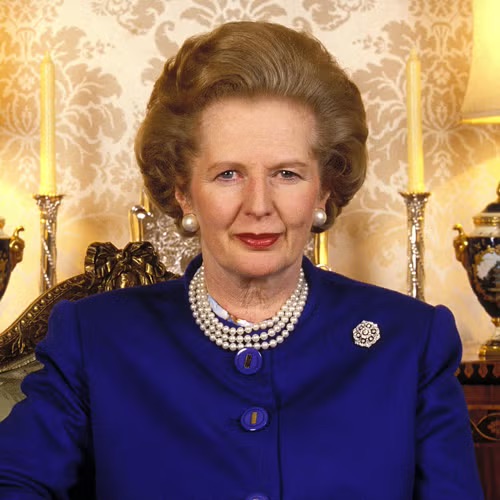
Margaret Thatcher, Prime Minister of the United Kingdom
Margaret Thatcher
Heritage 1979 — 1990
Heritage

Heritage · United Kingdom · 1979 — 1990

Margaret Thatcher

The Iron Lady's legacy: from stagflation to popular capitalism. How she transformed the British economy by accepting three years of pain to avoid thirty years of agony.
83% → 40% top income tax rate, from Callaghan to Thatcher
29,5 M strike days in 1979 when she took office. By 1990: 1.9M (ONS)
3M → 11M British shareholders before/after the privatisations
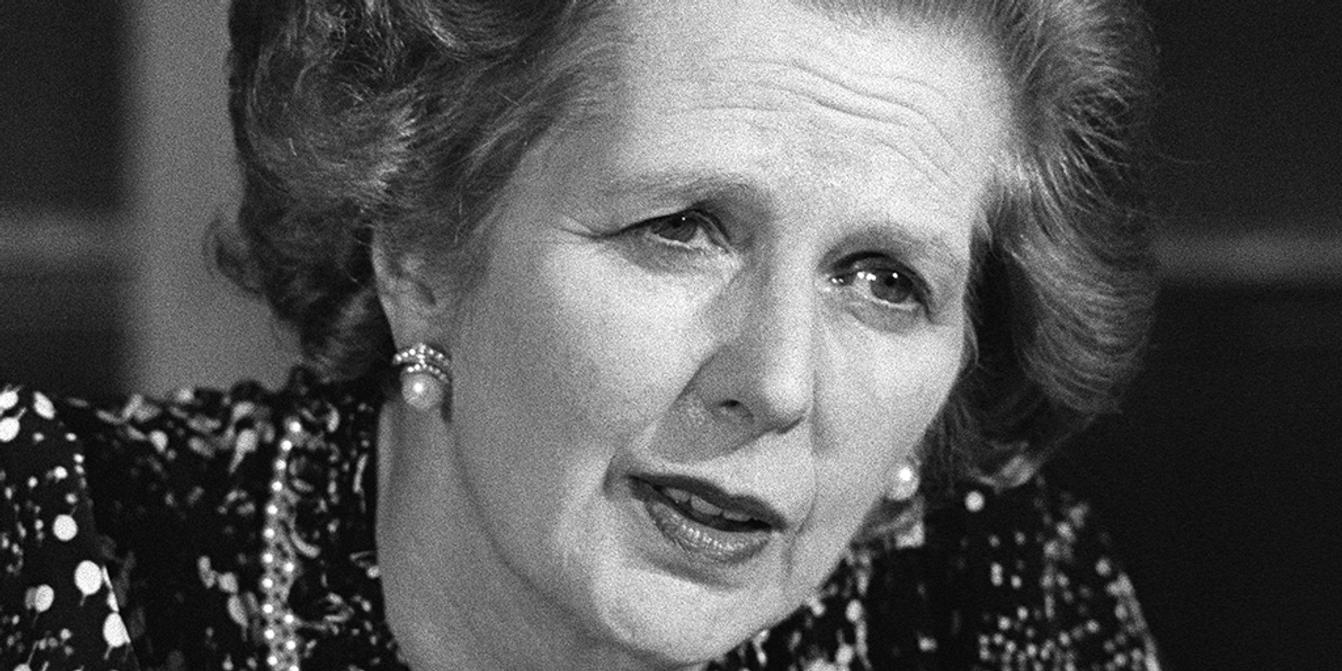
Margaret Thatcher, British Prime Minister (1979–1990)
01

The sick man of Europe

Want to understand Thatcher? Start by understanding what she inherited. In the 1970s, the United Kingdom was disintegrating. Prices were spiralling — inflation exceeded 24% in 1975 — while the economy was collapsing. Both at once. Trade unions wielded near-absolute power: they could turn the national electricity on or off at will.

The winter of 1978-79 entered history as the "Winter of Discontent". Rubbish trucks piled up in London streets. Gravediggers refused to bury the dead. Lorry drivers paralysed supply chains. That's the chaos she inherited.

"29.5 million working days lost. In a single year." Strikes and inflation in the UK (1970–1990)
💡 The key takeaway This picture isn't here to excuse what follows — it's here to show what "doing nothing" looked like. Every successive British government had chosen inaction since 1945. Inaction had a cost. Thatcher decided that cost was unacceptable.
02

Kill inflation, whatever the cost

The first budget of her Chancellor Geoffrey Howe in June 1979 was a deliberate shock. Interest rates climbed to 17% to choke off inflation. Brutal, and intentional. The 1980-81 recession was the worst since the 1930s. Thatcher did not yield — she refused the famous "U-turn" everyone was demanding: "You turn if you want to. The lady's not for turning."

Result: inflation, which was approaching 18% when she took office, fell to 3.4% by 1986. The medicine was bitter. The alternative — keeping the printing presses running to fund state spending — meant going cap in hand to the IMF, as Wilson had done in 1976.

"Interest rates at 17%. Recession accepted. Inflation at 3.4% by 1986." Inflation and Bank of England base rate (1979–1990)
💡 The key takeaway Bringing inflation from 18% to 3.4% was not just monetary policy — it was the deepest social reform of her tenure. Inflation is an invisible tax that hits hardest those who own no assets. Every hour under 1970s inflation, household savings melted. Stabilising the currency meant giving ordinary Britons their purchasing power back.
03

The selling state — stop the bleeding, unlock productivity

In 1979, the major nationalised industries were costing the British state around £3 billion a year. British Steel lost £1.78bn in 1980/81. Before British Airways could be sold, the government had to write off £900m of debt. The nationalised coal industry swallowed more than a billion a year in subsidies. These companies were not public assets — they were holes in the budget.

Privatisation ended that bleeding — and triggered a productivity transformation. British Steel cut its workforce by 70% while maintaining output: output per employee tripled. British Airways went from the world's worst airline to its most profitable in under five years. British Telecom cut phone installation time from eighteen months to a few days.

"British Steel: −£1.78bn in 1980. Profitable by 1989." Annual cost to state → annual profit after privatisation (click for details)

Click a company to see its before/after.

💡 The key takeaway Privatisation was not a giveaway — it was the end of a haemorrhage. Every year of state ownership cost taxpayers what privatisation later returned in profits, corporation tax and dividends for millions of small shareholders. Coal, which Thatcher never privatised, kept costing billions until its closure under Major — proof that keeping the state as owner saved nothing.
04

The tax liberation

In 1979, a doctor earning £50,000 kept just 29% of their salary. The state took 83% on every extra pound earned beyond a certain threshold. Her Chancellor Nigel Lawson's 1988 budget radically simplified: just two rates, 25% and 40%. It was the biggest British post-war tax reform.

The effects were immediate: high earners who had fled abroad to avoid paying 83% came back. Building complex schemes to dodge tax became less worthwhile. And paradoxically, the state collected more tax from the wealthy after the rate cut — because they were no longer fleeing or avoiding.

"In 1979, a doctor on £50,000 kept 29% of their salary. In 1988: 69%." What you keep from your gross salary

Pick a profile or adjust the gross salary. How much did the state leave you?

💡 The key takeaway The Thatcherite paradox: when the top rate fell from 83% to 40%, the state collected more. High earners who had fled abroad came back. Tax avoidance schemes became less worthwhile. The share of revenue paid by the top 1% rose after the rate cut. This isn't theory — it's what happened in the UK between 1979 and 1990.
05

Taming the unions

In 1979, a union could force all employees in a company to become members — or face dismissal. It could call a sympathy strike with another sector, without a vote, on the say-so of union officials. It enjoyed near-total legal immunity. Control the unions and you controlled the country.

Thatcher didn't abolish unions. She changed the rules with four acts between 1980 and 1988. The 1984-85 miners' strike was the full-scale test: a year-long standoff, 10,000 arrests, and the miners returned to work having gained nothing. The union veto over the country's economic decisions ended that day.

"29.5M working days lost in 1979. 1.9M in 1990. Same unions, different rules." What changed in 8 years
Unions in 1979 — unlimited power
Closed shop: to work here, you must join the designated union — or you're fired.
Sympathy strike without ballot or limit: the union decides, everything stops.
No mandatory secret ballot: strikes called by officials without consulting members.
Total immunity: impossible to sue a union for damages caused.
29,5M days lost in 1979
💡 The key takeaway The figure is stark: 29.5 million working days lost in 1979. 1.9 million in 1990. Same unions — different rules. Thatcher didn't destroy the union movement: she reintroduced democracy inside unions with the mandatory secret ballot. It was union leaders themselves — not Thatcher — who feared their members would vote against striking.
06

Big Bang — the City unleashed

In 1986, the London Stock Exchange still operated like a Victorian club: transaction commissions were fixed by decree, negotiating the price of a deal was forbidden. Brokers and market-makers were kept apart by strict rules. Foreign banks couldn't buy British firms. Result: a City seizing up while New York and Tokyo accelerated.

On 27 October 1986, everything changed in a single day. The 'Big Bang': free commissions, abolition of role separation, electronic trading, opening to foreign banks. Within three years, London's trading volumes tripled. London took the number one global spot in foreign exchange markets — a position it still holds today.

"London's share of global foreign exchange: 15% in 1979. 25% in 1989." Who dominates foreign exchange (1979 vs 1989)

Each country's share of global foreign exchange turnover. Source: BIS (Bank for International Settlements), 1989.

💡 The key takeaway In 1979, Wall Street dominated and London was declining. By 1989, London had become the world's number one foreign exchange centre — a position it has never lost. Today, the City accounts for roughly 10% of British GDP and generates a third of corporate tax receipts. The Big Bang turned London into a direct competitor to New York rather than a Victorian museum frozen in another era's rules.
07

Homeownership — the right the state denied

In 1979, one in three Britons lived in state-rented housing with no right to buy it. This was institutionalised dependency: for a stable roof over your head, you stayed a government tenant for life. Thatcher saw this as a fundamental injustice — not protection, but a gilded cage preventing working-class families from building any wealth.

The 1980 Housing Act created the 'Right to Buy': any council tenant could purchase their home at a 33-50% discount based on their length of tenure. In ten years, 1.5 million families — mostly working-class — became homeowners for the first time. Homeownership rose from 55% to 67%. For many, it was the first time in their family's history.

"55% homeowners in 1979. 67% in 1990. 1.5 million families." Who owns their home in the UK (1971–2001)

Gold: owner-occupied. Grey: council housing. Light: private rental. Source: ONS / English Housing Survey.

💡 The key takeaway 1.5 million working-class families — bus drivers, nurses, factory workers — became homeowners for the first time between 1980 and 1990. For many, it was the first asset their family had ever owned. Owning your home isn't just a roof: it's savings, security, and the end of dependence on the state as landlord.
08

The objections — turned around

Mines closed, record unemployment, state companies sold off, social housing gutted. These are the four strongest charges against her. Look closer: each time, the real culprit was already there before she arrived.

Click a card to flip the objection.

01 ⛏️

"She closed the mines to crush the unions"

Flip →
01

By 1984, every ton of British coal cost more to produce than to import. The official management of the mines themselves estimated that three-quarters of pits were losing money. France, Germany, Belgium all closed their mines too — just ten to twenty years later, after spending billions more. Arthur Scargill knew miners would vote against the strike — he refused to hold the ballot. He was the one who sacrificed his own men.

02 📈

"3 million unemployed — that's her doing"

Flip →
02

Unemployment had already doubled under Callaghan between 1974 and 1979. The 12% peak of 1984 is the concentrated four-year cost of the restructuring Labour had refused to face for fifteen years. By 1990 when she left, unemployment was 6.9% — barely higher than when she arrived. France kept its "social" model and has carried a background level of 7-10% unemployment for forty years that never goes away. Short pain versus chronic pain.

03 🏢

"Privatisation means selling off the common good"

Flip →
03

"Common good" implies a common benefit. But BT took 18 months to install a phone. British Airways needed regular bailouts. British Steel lost £1.8bn in 1980. The "common good" meant paying for some people's inefficiency with other people's taxes. After privatisation: BT installation times from 18 months to days, telecoms prices halved in real terms, BA ranked number one worldwide. And shareholders went from 3 to 11 million — ordinary people owned more, not less.

04 🏠

"Right to Buy destroyed social housing without rebuilding it"

Flip →
04

Right to Buy allowed 1.5 million working-class families to become homeowners for the first time. The real problem was a Treasury rule preventing councils from using sale proceeds to build replacements — an accounting constraint imposed from above, not an ideology. More importantly: Labour governed for thirteen years (1997–2010) without rebuilding the stock. Blair and Brown built fewer social homes than Thatcher. Today's housing shortage comes from forty years of refusing to build — and every party shares the blame.

05 🏥

"She slashed public services — the working class paid the price"

Flip →
05

The NHS budget grew in real terms every single year of her time in office — from £7.9bn to £28bn. Life expectancy rose from 73 to 76. Infant mortality was halved. What she introduced was internal competition between hospitals to force efficiency — the same mechanism used today by the world's top-ranked health systems: Sweden, Netherlands, Germany. She didn't destroy the NHS. She forced it to ask why some hospitals cost twice as much for the same outcomes.

💡 The key takeaway Her policies weren't cruel — it was the politics of avoidance that was cruel. The scars of Thatcherism are the deferred cost of decades of inaction. She chose to pay cash rather than keep paying with interest.

Thatcher didn't make the British happy. She got them out of years of runaway inflation, unchecked union power, and state dependency. British living standards caught up with and overtook France and Italy from the 1980s onwards. She paid an enormous political price, especially in the industrial regions of the North. But the alternative — the Labour model of the 1970s — meant going to the IMF for help, as in 1976. She chose short pain over long agony. That's what governing means.